
If you’ve already implemented ISO 42001 – or are considering it – you will be better prepared for the EU AI Act than you think.
The EU AI Act, the world’s first comprehensive legal framework for artificial intelligence, introduces binding rules for how AI systems are developed, deployed, and monitored. For those of you working on enterprise AI, understanding how to meet these obligations efficiently is critical. That’s where ISO/IEC 42001, the first international AI management system standard, becomes a strategic asset.
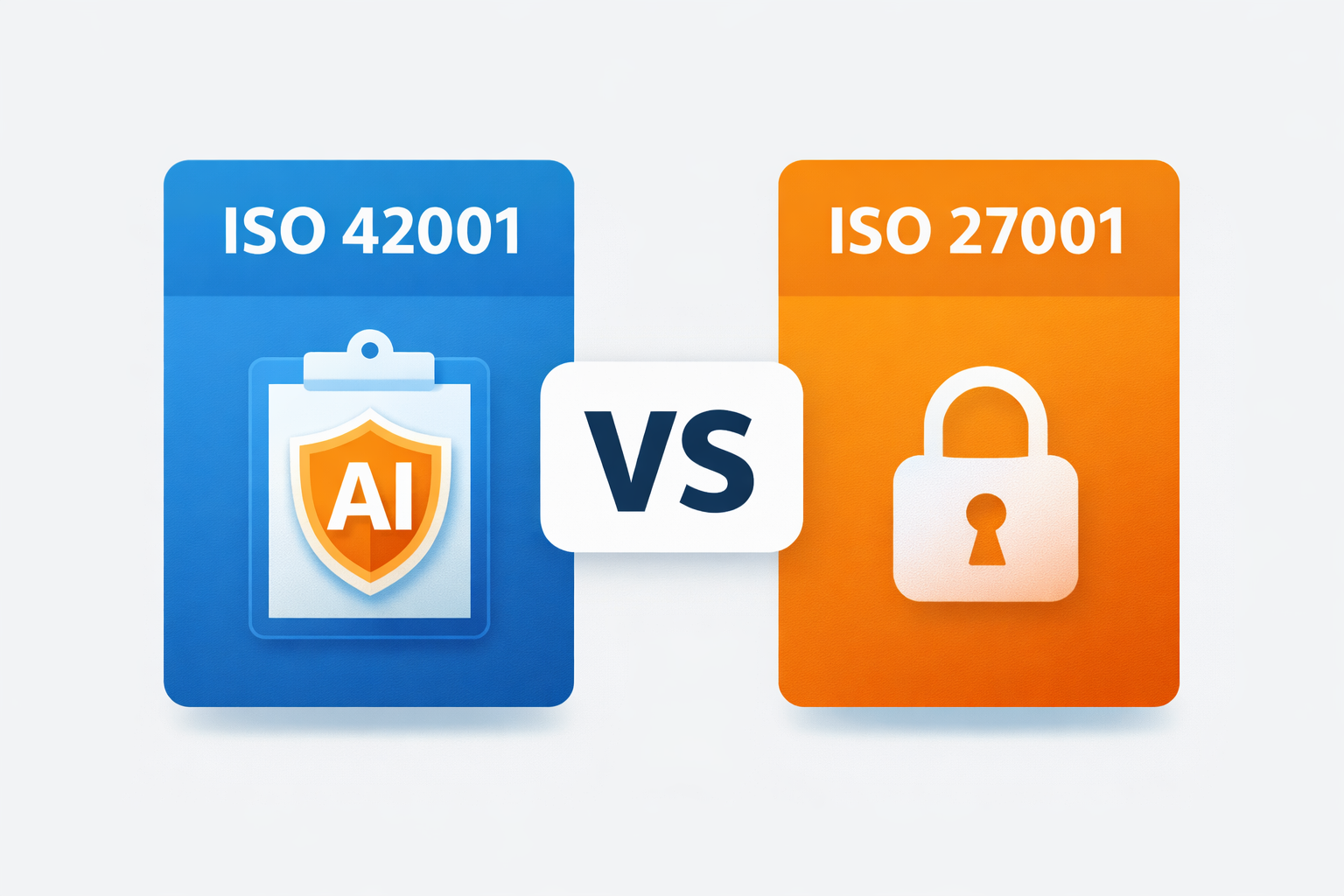
Broadly speaking, ISO/IEC 42001 is closer to the “how you run AI management in practice,” while the EU AI Act is the “what you must achieve” in legal terms, especially for high‑risk systems.
Understanding the EU AI Act and ISO 42001
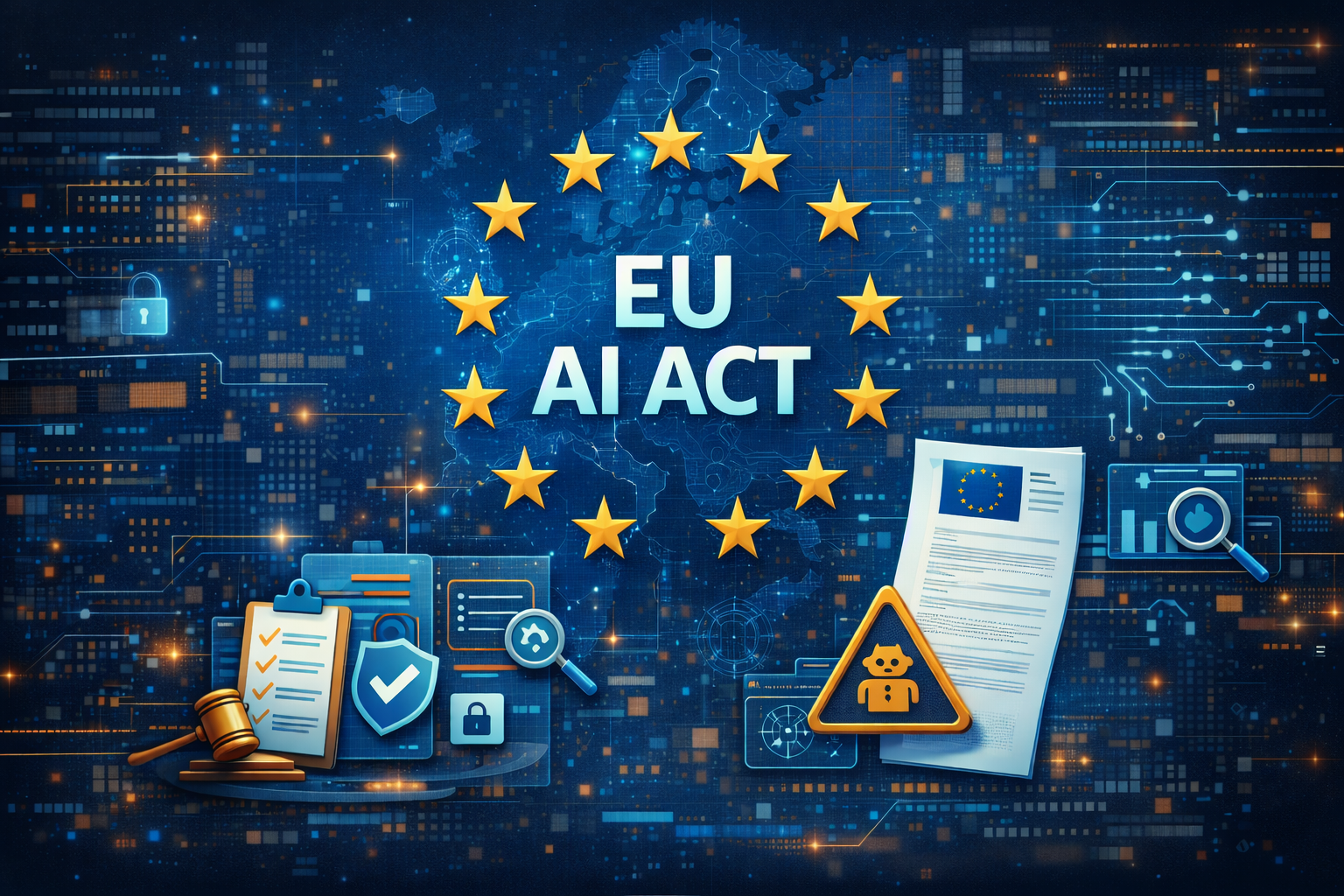
The EU AI Act, effective from 2nd August 2026 for high-risk systems, is a mandatory regulation that applies not just to EU-based organisations but also to those companies offering AI services in the EU. Its goal is to ensure safe, ethical, and human-centric AI by categorising AI systems by risk level and imposing stricter controls on high-risk systems.
The EU AI Act came into force on 1st August 2024, but its obligations apply in phases, in order to allow enterprises time to prepare, with the majority becoming binding on August 2, 2026.
- Unacceptable-risk AI (e.g., social scoring) and general AI literacy rules applied from 2nd February 2025.
- General-purpose AI (GPAI) model rules started 2nd August 2025, with full compliance for pre-existing GPAI by 2nd August 2027.
- High-risk AI systems (e.g., in biometrics, education) and most enforcement rules bind from 2nd August 2026, when authorities gain full powers.
By contrast, ISO 42001 is a voluntary, certifiable international standard published by ISO/IEC in late 2023. It helps organisations all across the globe build a formal AI Management System (AIMS) – a framework of policies, processes, and governance structures to manage AI responsibly across its lifecycle. The standard was an international collaborative effort (built with the participation of 63 countries) and describes how an organisation should establish, implement, maintain and continually improve structured AI governance and processes.
Despite one being a binding EU regulation and the other a voluntary international standard, they are highly aligned in purpose and structure.
A good mental model Governova uses is that: EU AI Act ≈ “what you must do / outcomes you must meet to be compliant in the EU”; ISO 42001 ≈ “how you organise and operationalise AI management so those outcomes are consistently met”.
Even if your business doesn’t currently operate in the EU, ISO 42001 remains a valuable investment. As AI regulations emerge globally – from the U.S. Executive Order on AI to Canada’s AIDA and upcoming frameworks in Asia-Pacific – ISO 42001 provides a unified, internationally recognised foundation for AI governance. It helps future-proof your operations, reduces regulatory risk as markets evolve, and signals to partners, customers, and investors that your AI systems meet high standards of safety, fairness, and accountability, regardless of jurisdiction. In many ways, it’s the AI equivalent of what ISO 27001 became for information security: a global trust signal.
How the Two Frameworks Overlap
While the EU AI Act and ISO 42001 are distinct in legal force and scope, there’s a 50% overlap in their high-level requirements. These intersections make ISO 42001 a practical foundation for organisations preparing for EU compliance.
Here are five major areas where they align:
1. Data Governance
- EU AI Act (Article 10) mandates high-quality training, validation, and testing datasets, including steps to detect and correct bias.
- ISO 42001 requires organisations to define roles for data governance and calls for processes to identify and mitigate bias in datasets and AI outputs.
2. Risk Management
- The EU AI Act uses a four-tier risk classification – unacceptable, high, limited, and minimal – with strict requirements for high-risk systems.
- ISO 42001 includes formal risk assessment procedures to classify, assess, and treat AI-related risks in a similar structure.
3. Human Oversight
- Article 14 of the EU AI Act states that AI systems must allow for effective human oversight, tailored to the level of risk.
- ISO 42001 supports this by requiring transparency in system behavior and thorough documentation to enable oversight and auditability.
4. Ethical and Societal Impact
- Both the EU AI Act and ISO 42001 emphasise fairness, non-discrimination, and the prevention of harmful outcomes, especially for systems affecting people’s rights or access to services.
- ISO 42001 further recommends assessing the impact on stakeholders and societal well-being as part of the AIMS framework.
5. High-Risk Systems and Prohibited Use Cases
ISO 42001 encourages detection and discontinuation of systems that conflict with legal or ethical standards, supporting conformance with these prohibitions.
The EU AI Act prohibits certain use cases entirely (e.g., untargeted facial recognition in public spaces).
ISO 42001 Can Accelerate Your EU AI Act Compliance
Because of these overlaps, an existing ISO 42001 certification can serve as a baseline for EU AI Act readiness. For example, organisations with robust AIMS processes already in place can:
- Reuse documented controls for risk management and data handling
- Leverage internal audits and monitoring mechanisms for ongoing compliance
- Demonstrate due diligence in areas like bias detection and human oversight
Since ISO 42001 requires a formal, auditable AI Management System (AIMS), it forces teams to establish governance structures, risk assessment processes, documentation, and oversight mechanisms that closely mirror the operational expectations of the EU AI Act. In practice, this makes ISO 42001 an effective first step toward EU AI Act compliance, giving organisations a structured baseline they can extend rather than building compliance controls from scratch under regulatory pressure.
Strategic Pathways to Compliance
Depending on where you are in your compliance journey, you have two main options:
If you’re already ISO 42001-certified:
- Cross-reference your existing AIMS with the EU AI Act requirements.
- Identify and close compliance gaps, especially in areas the Act emphasises like transparency, documentation, and post-market monitoring.
- Submit a Declaration of Conformity for your high-risk systems once aligned.
If you’re not ISO 42001-certified yet:
- You can either start directly with the EU AI Act, focusing on mandatory elements like conformity assessments and self-attestation…
- …or invest in ISO 42001 first, to build a sustainable AI governance foundation that supports long-term compliance across multiple jurisdictions.
While the EU AI Act has legal ramifications – including fines of up to €35 million or 7% of global turnover – ISO 42001 offers strategic advantages. Certification demonstrates proactive commitment to responsible AI and can differentiate your brand in enterprise and public-sector procurement processes.
What Does ISO 42001 Certification Look Like in Practice?
To become ISO 42001-certified, the process typically involves:
- Studying the standard (10 clauses + 4 annexes)
- Conducting a gap analysis against current AI systems
- Building or updating your AI Management System (AIMS)
- Documenting controls for traceability and audit-readiness
- Monitoring your AIMS continuously for effectiveness and improvement
Similarly, for EU AI Act compliance:
- Assess applicability of the Act to your AI systems (especially high-risk classifications)
- Conduct a conformity assessment, focusing on transparency, data governance, record-keeping, and more
- Document policies and implementation details
- Submit your Declaration of Conformity
- Implement post-market monitoring to track ongoing performance and compliance
So Does ISO 42001 Compliance Help You Comply with the EU AI Act?
Absolutely, by implementing ISO 42001, you lay the operational groundwork – the necessary processes – for meeting the EU AI Act’s legal obligations faster and with greater confidence. ISO 42001 and the EU AI Act aren’t competing frameworks – they’re complementary.
In a regulatory landscape that’s growing more complex by the year, combining certifiable standards like ISO 42001 with mandatory laws like the EU AI Act is the most thorough and scalable path forward for responsible AI.
If your organisation is building or deploying AI in the EU, this dual approach is smart governance.